Tuesday, 19 April 2011

Spaces where you play games cont.

Home
When gaming moved into the home it did make a large impact with interaction between people. In many cases with a lot of games there is no interaction with other people, isolating the player from others; this is one of the reasons why the gaming culture isn’t looked upon very well by society, as it apparently creates recluses.  
unfinished

Spaces where you play games

Arcades
Went out on to Weston super mare and took the opportunity to look into the arcades, the kinds of games they had available and the overall atmosphere in comparison to playing games at home. Upon entering all of the arcades I visited the atmosphere was bright, crowded – as in lots of people and even by just looking I spotted at least 5-10 arcade games that had a multiplayer capability which involves direct interaction between players, even more so with the games that needs teamwork to progress. Eg Time Crisis, House of the dead : when playing multiplayer.
Compared to playing at home it does feel like I’m mingling more with other people; for instance, while I was playing Time Crisis 3 a woman behind me kept yelling for what I part of a boss I should have been shooting. I can’t really say much for arcades back then but the audience that they attract nowadays is very varied, children and older aged audiences were playing the games; as opposed to a community of online players there are very few hardcore gamers seen around arcades, so therefore should be little hierarchy over certain games; one of the most intimidating things for some gamers is when coming into contact with the hard core gamers, being put down by them/ harassed. The environment just seemed like a happier place than playing at home or online; most of the people I saw were families or groups of friends. Arcades are an interesting gaming space as it has the enjoyment of gaming but also interaction and bonding with people who are out with you.

Tuesday, 12 April 2011

Women and Gaming, and online gaming

As a pair the two seem to rarely go hand in hand, one of the books I had read prior to this project was ‘Play between worlds’, as I started to read this I didn’t actually know that this was a woman who wrote it and just instantly assumed that it was a man’s perspective on online gaming and its culture; I found it interesting that it was a book actually from the gamers perspective unlike quite a few books on gaming and its culture, but the fact it was a woman surprised me. It’s a good example of stereotyping the gaming culture, mainly men are seen to be gamers; especially so with online gaming, and I don’t actually know why for that matter, it’s just the first thing that comes to mind with that subject.
Her book mentions about the gaming culture, “powergamers” how it as seen more as work that for the actual enjoyment; and finally women players, the stereotypes and how the industry doesn’t seem to acknowledge them or have over generalised what we like in them.
She researches first hand with an MMOG she plays called ‘Ever Quest’, from her starting her first character in the game; going surprisingly in depth with just that alone. That creating a character on games like these shows a lot of the players psyche, for instance she describes her process in the stages of gender, race and class wanting to choose a female character like herself as she is in real life; the races for the game having their own special traits, she ended up choosing to be a gnome as a lot of the other female races were over sexualized and her other option being a human “...human character didn’t appeal to my experimental side.”
She had a theory that choosing the gnome race wouldn’t attract as much attention from male players “I believe I received many fewer ‘hey baby’ comments...” She later experiments with this generalisation in the book. It does raise the interesting question, why do many male players on MMOG games seem to take notice of the pretty female avatars in the game? They may not even be a female gamer for all they know; they’re trying to get an avatars attention. Choosing her avatars class as a necromancer even went into good deal of detail, in another attempt being a warrior instead she felt more under pressure as more people relied on the hard hitter as opposed to her necromancer; “...I was more inclined to pick character that would let me hang back in the shadows and be somewhat self sufficient...” , “Much like my offline personality.” So even in a fantasy set game, when it comes to character creation some of your self will always bleed through into the creation process.
Taylor makes an insightful comparison with online games, similar to ‘Ever Quest’ with ‘Dungeons and Dragons’, the process of creating your own character; the adventuring with groups of other players. Both also involve interaction with other players, socialising and working with others, with differences like if one person in a D&D campaign group isn’t there it’s difficult to actually progress; whereas with online games it’s just a case of the once person signing onto the system, if their friends/ teammates aren’t there, they can still just adventure solo or meet other players.

Group work: Comparrison of Female/male character and backgrounds

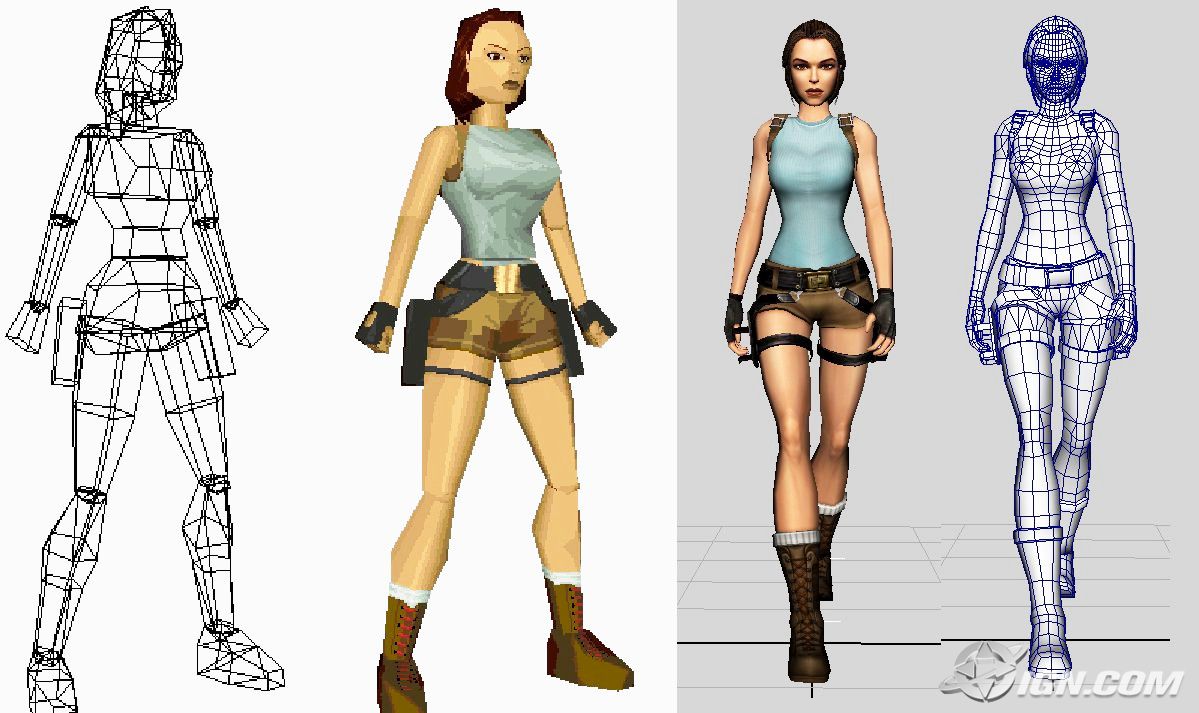
Comparison between male/ female / other characters, older pixel/ low poly characters to new high definition characters.
Our group chose for this part of the comparison ‘Tomb Raider’s’ Lara Croft, as we could use evidence of the progression with that same character; what changes were made over time. Original Lara was a very low polygon character, comparing to the newer models of her, her proportions have greatly improved from her ‘pointy’ image; clothes aren’t just simple textures on the model and the texture for her clothing has greater detail to is; like the weave of the fabrics or scuffs on her boots. The polygons count is obviously higher for her new models so her overall figure has smoothed out over time. This progression was a given that it would happen, as technology had improved capabilities and the Tomb Raider series had more money to spend her development; whereas graphically back when she first made her debut, although the graphics were impressive back then they couldn’t do an amazing amount with her appearance because of the limitations, so the focus was on her character mainly; however her design was simple but iconic a light blue/green leotard, brown shorts, tiny back pack, long plait, twin pistols and her insane hourglass figure.
The male comparison our group chose, similar to Lara Croft, was ‘Resident Evil’s’ Chris Redfield; he has gone through a transformation over the series instalments (Albeit he hasn’t been featured in every one of them) His original appearance was mostly made up of squares, and his clothing and face simply textured on. However unlike Lara as the series progressed Chris has developed much more over time than Lara Croft, he has actually aged, or in the Resident Evil 5’s case bulked up on muscle considerably; but even with that he is still easily distinguished as the same character, with his pose and general attire. What made Chris stand out was that fact he was a strong character, ‘The best of the best’, what time couldn’t be spent on the actually character back then they also focused with him as a person.


A pixel/ flat environment and a high def, sound environment.
Resident Evil 1
The original Resident Evil games environments were all pre-rendered so camera angles had to be fixed, immersing one’s self into a setting like was somewhat difficult in comparison to newer games were the camera looks where you wish to look; our group chose fairly new indie game ‘Amnesia’, the game is first person so both have the same, ‘wondering what’s round the corner’ mechanism working for them; which I think is possibly one of the most useful techniques for horrors.
With Resident Evil the pre-rendered backgrounds were fairly simple in comparison to other games which have the same use of environments; actual interaction with the environment was difficult because of this, things that were moveable were easily noticeable as they couldn’t be rendered in or if they were then it could cut to the object already moved. However, personally I did find these environments really worked the fixed angles just had this edge that made the whole situation creepy, only being allowed to see that area unless you progressed; hearing strange noises around the corner. It was a very atmospheric technique, which is a shame newer horrors don’t look back on the older ones and draw from its strengths; with horror atmosphere is everything.
Amnesia on the other hand, is without a doubt much more detailed and managed to keep atmosphere present with the first person perspective, you weren’t able to see around corners; the lighting also plays to its strengths in this game, something earlier games were unfortunately not well executed for graphical reasons. Virtually everything in the environment you are able to interact with, so you could use makeshift weapons of simply throwing a vase, hiding in a wardrobe (Which is a frequent occurrence in this game as confrontation is the last thing on the list in this game unlike RE1); or could work to your disadvantage by bumping into the objects, excessive noise can attract attention. This is a really intuitive feature, forcing the player to think before even doing the simplest tasks and comes with the constant fear of “Did something hear me?”.